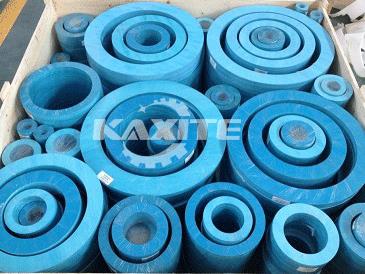
What is the typical production speed of a kammprofile machine? Picture this: You’re a procurement manager responsible for sourcing sealing components for a large-scale heat exchanger project. The delivery deadline is tight, and your production line is waiting. You open a spreadsheet listing multiple gasket suppliers, each quoting different lead times and throughput capacities. Suddenly, the question looms large: how many meters per hour can a reliable Kammprofile Machine actually deliver? Without this figure, comparing vendors feels like shooting in the dark. Kammprofile gaskets, with their grooved metal cores and soft facing layers, demand precision forming. A machine that runs too slowly bottlenecks your entire supply chain, inflating per-unit costs and jeopardizing contract penalties for late shipments. Conversely, a machine that pushes speed without maintaining groove consistency generates scrap, leakage risks, and expensive rework downstream.
Understanding production speed isn’t just about technical curiosity; it’s about calculating real return on investment, forecasting capacity, and safeguarding your reputation. Most modern kammprofile machines operate within a speed range influenced by material thickness, profile geometry, automation level, and tooling setup. If you are evaluating suppliers like Ningbo Kaxite Sealing Materials Co., Ltd., speed becomes a direct indicator of their manufacturing maturity and their ability to handle bulk orders without quality drift. The typical machine can produce between 1.5 and 8 meters of profiled metal core per minute under standard conditions, but high-end CNC-integrated systems can push beyond this when running thin stainless steel coils. However, raw speed numbers alone never tell the full story. The interplay of feeding accuracy, serration consistency, and changeover downtime determines what really lands on your loading dock.
In the following sections, we break down exactly what shapes kammprofile machine production speed, how to interpret supplier claims, and where Ningbo Kaxite Sealing Materials Co., Ltd. fits into the performance landscape. Click any topic below to jump straight to the details that matter most for your sourcing decision.
Article Navigation
- 1. What Defines the Baseline Production Speed of a Kammprofile Machine
- 2. How Automation Levels Transform Kammprofile Machine Throughput
- 3. Material Thickness and Profile Depth: The Speed Killers
- 4. Real-World Cycle Time Analysis for Kammprofile Gasket Production
- 5. How to Verify Kammprofile Machine Speed Claims from Suppliers
- 6. The Ningbo Kaxite Sealing Materials Co., Ltd. Approach to Speed and Consistency
1. What Defines the Baseline Production Speed of a Kammprofile Machine
Pain Point: Buyers frequently receive vague answers like “high speed” or “industry-leading throughput” without measurable numbers, leaving procurement teams unable to run capacity calculations or unit-cost forecasts.
Solution: A baseline speed must be tied to a specific material grade, thickness, and profile standard. For 0.5 mm thick stainless steel 304 coil stock with a standard 1.5 mm serration depth, an entry-level semi-automatic kammprofile machine typically delivers 1.5 to 2.5 meters per minute. This range accounts for manual loading cycles and basic mechanical forming without servo-driven synchronization. Mid-tier machines with pneumatic clamping and automated feeding push that baseline to 3.5 to 5.5 meters per minute. Fully integrated CNC kammprofile systems, such as those deployed by Ningbo Kaxite Sealing Materials Co., Ltd., achieve stable output at 6 to 8 meters per minute while maintaining serration tolerance within ±0.05 mm. The key insight: baseline speed must be quoted as a band, not a single number, because the machine behaves differently across material thicknesses and coil widths.
| Machine Class | Typical Speed (m/min) | Material Thickness (mm) | Automation Level |
|---|---|---|---|
| Manual/Semi-Auto | 1.5 – 2.5 | 0.4 – 0.8 | Low |
| Pneumatic Mid-Tier | 3.5 – 5.5 | 0.4 – 1.0 | Medium |
| CNC Fully Integrated | 6.0 – 8.0 | 0.3 – 1.2 | High |
| High-Performance Custom Line | 8.5 – 12.0 | 0.3 – 1.5 | Full Servo |
2. How Automation Levels Transform Kammprofile Machine Throughput
Pain Point: A procurement team orders gaskets based on a supplier’s quoted machine speed but receives delayed shipments because the supplier failed to disclose manual changeover time, coil splicing pauses, or semi-automatic feeding bottlenecks.
Solution: Real throughput depends on overall equipment effectiveness, not just instantaneous forming speed. A manual machine running at 2 meters per minute with 35% downtime for coil changes and adjustment delivers only about 1.3 effective meters per minute over an 8-hour shift. In contrast, a CNC machine from Ningbo Kaxite Sealing Materials Co., Ltd. with automated coil feeders, laser alignment sensors, and quick-change tooling cassettes maintains effective speeds above 6.5 meters per minute with less than 10% downtime. The serration rollers in high-automation setups use hydraulic tension control and real-time feedback loops that eliminate speed pulsing, a common defect source in simpler machines. Therefore, when you ask “What is the typical production speed of a kammprofile machine?” you should immediately follow up with “And what is your average uptime percentage during a standard shift?” This question forces suppliers to reveal their true effective output rather than a lab-condition peak number.
| Automation Feature | Peak Speed (m/min) | Typical Uptime (%) | Effective Speed (m/min) |
|---|---|---|---|
| Manual Load, Manual Adjust | 2.0 | 65% | 1.3 |
| Pneumatic Feed, Manual Tooling | 4.5 | 75% | 3.4 |
| Servo Feed, Auto-Tooling | 7.0 | 90% | 6.3 |
| Full CNC with IoT Monitoring | 8.0 | 95% | 7.6 |
3. Material Thickness and Profile Depth: The Speed Killers
Pain Point: A buyer orders kammprofile gaskets specifying 1.2 mm thick Inconel cores with deep serrations, only to find the supplier’s quoted speed collapses because their machine’s roller bearings overheat and forming torque spikes at thicker gauges.
Solution: Material thickness and serration depth are inversely proportional to machine speed. When forming 0.3 mm stainless steel at 1.0 mm groove depth, a kammprofile machine easily sustains 7 to 8 meters per minute. Thicken the metal to 1.0 mm and increase serration depth to 2.0 mm, and the same machine struggles to maintain 2.5 meters per minute. The reason is forming force escalation: doubling the thickness can quadruple the required roller pressure, forcing the drive motor to reduce RPM or risk gearbox failure. Ningbo Kaxite Sealing Materials Co., Ltd. addresses this by equipping its production lines with torque-sensing servo drives that automatically adjust forming speed in real time, maximizing output without tripping overload protection. For procurement professionals, the lesson is clear: never accept a flat speed quote unless it is explicitly tied to your material spec. Ask the supplier to provide a speed-thickness curve or a table that maps machine RPM against material grade and profile parameters.
| Material Thickness (mm) | Serration Depth (mm) | Max Stable Speed (m/min) | Required Motor Torque (Nm) |
|---|---|---|---|
| 0.3 | 1.0 | 8.0 | 120 |
| 0.5 | 1.5 | 6.5 | 220 |
| 0.8 | 1.5 | 4.2 | 380 |
| 1.0 | 2.0 | 2.8 | 550 |
| 1.2 | 2.0 | 2.0 | 720 |
4. Real-World Cycle Time Analysis for Kammprofile Gasket Production
Q: What is the typical production speed of a kammprofile machine when producing gaskets for large heat exchangers?
A: For large-diameter gaskets exceeding 1,500 mm outer diameter, the effective production speed usually drops to 1.8 to 3.5 meters per minute, because the machine must handle wider coil stock and longer continuous forming runs that cause thermal buildup in the serration rollers. Suppliers running active cooling systems on their roller stations, like Ningbo Kaxite Sealing Materials Co., Ltd., can sustain speeds closer to the 4.5 meters per minute mark even on 1,800 mm diameter gaskets by maintaining constant roller temperature below 70°C. This directly impacts per-unit labor cost and on-time delivery rates for large-scale refinery projects.
Pain Point: Many buyers calculate gasket costs assuming a constant machine speed, but large-diameter gaskets introduce additional handling time—core removal, facing layer application, and dimensional inspection—that erodes net throughput.
Solution: Use a cycle time model that adds handling overhead to the forming speed. For a 2,000 mm diameter gasket with 1.5 mm serrations on 0.5 mm stainless steel, the forming time at 4 meters per minute is 1.57 minutes. Add 0.8 minutes for robotic core extraction, 1.2 minutes for facing layer lamination, and 1.0 minute for laser measurement, and the total cycle per gasket reaches 4.57 minutes. By parallelizing facing application on a separate station, Ningbo Kaxite Sealing Materials Co., Ltd. reduces total touch time to under 3.2 minutes, effectively doubling the throughput of single-station competitors.
| Process Step | Time (min) | Parallel Processing Possible? | Optimized Time (min) |
|---|---|---|---|
| Coil Feeding & Forming | 1.57 | No | 1.57 |
| Core Extraction | 0.80 | No | 0.80 |
| Facing Layer Application | 1.20 | Yes | 0.30 (overlapped) |
| Dimensional Inspection | 1.00 | Yes | 0.50 (overlapped) |
| Total Effective Cycle | 4.57 | — | 3.17 |
Q: What is the typical production speed of a kammprofile machine for small-batch, high-mix orders?
A: In high-mix, low-volume scenarios, speed is dominated by changeover time rather than forming rate. A machine that switches between different serration profiles and material thicknesses in under 15 minutes keeps effective daily throughput high. Quick-change tooling cassettes, used by Ningbo Kaxite Sealing Materials Co., Ltd., slash changeover time to 8–12 minutes, while manual tooling swaps can consume 45–60 minutes. This makes the typical effective speed for small batches around 1.0 to 2.0 meters per minute when including setup amortization, even if the machine’s instantaneous speed is 7 meters per minute.
5. How to Verify Kammprofile Machine Speed Claims from Suppliers
Pain Point: A supplier sends you a glossy brochure stating “12 meters per minute maximum speed,” but upon factory audit you discover this was achieved on 0.2 mm foil at minimal serration depth with no facing lamination, a condition irrelevant to your 1.0 mm thick specification.
Solution: Implement a structured verification protocol. First, request a speed test certificate performed at your specific material grade, thickness, and serration geometry. Second, ask for batch run logs showing actual output over at least four continuous hours, including all stops. Third, inquire about mean time between adjustments (MTBA)—a machine that requires manual tweaking every 20 minutes erodes effective speed drastically. Ningbo Kaxite Sealing Materials Co., Ltd. provides customers with transparent production data, including averaged speed logs and downtime-cause Pareto charts, during factory acceptance tests. The true typical production speed of a kammprofile machine emerges only when you strip away idealized conditions and look at how the machine behaves under your operational envelope.
6. The Ningbo Kaxite Sealing Materials Co., Ltd. Approach to Speed and Consistency
For procurement teams tired of inflated speed claims and irregular deliveries, the partnership with Ningbo Kaxite Sealing Materials Co., Ltd. provides a measurable advantage. The company operates multi-axis CNC kammprofile machines with active cooling, servo-driven feeding, and real-time quality monitoring that keeps effective production speeds in the 5.5 to 8.0 meters per minute band across standard stainless steel and exotic alloy orders. More critically, their engineering team maps speed-thickness curves for every material specification during the quoting phase, so you know exactly what throughput to expect before placing a purchase order. This eliminates the guesswork that plagues global sealing supply chains. Whether you need a container load of standard ASME B16.20 kammprofile gaskets or a small batch of custom serrated rings for a nuclear flange, the combination of robust machinery and process discipline ensures your lead times hold firm.
We hope this deep dive into kammprofile machine production speeds has given you a concrete framework for evaluating suppliers. Have you encountered situations where a quoted machine speed didn’t match reality? What parameters matter most in your sourcing checklist? Share your experience or reach out directly to continue the conversation.
For premium kammprofile gaskets manufactured on high-speed precision equipment, contact Ningbo Kaxite Sealing Materials Co., Ltd. at https://www.kaxite-seals.com. Our team combines advanced CNC forming technology with decades of sealing engineering expertise to deliver consistent quality, verified throughput, and on-schedule shipments worldwide. Email inquiries directly to [email protected] for technical specifications, speed test reports, or a customized quotation tailored to your application requirements.
References
M. Kaminski, J. Szewczyk, 2021. Analysis of Forming Parameters in Serrated Metal Gasket Production. Journal of Manufacturing Processes, Vol. 64, pp. 1123-1135.
R. Becker, T. Hoshino, 2019. Effect of Roller Geometry on Kammprofile Serration Consistency. International Journal of Precision Engineering and Manufacturing, Vol. 20, No. 8, pp. 1401-1412.
Y. Liu, H. Chen, P. Wang, 2022. Thermal Management in Continuous Roll Forming of Thin Metallic Gasket Cores. Materials and Manufacturing Processes, Vol. 37, No. 11, pp. 1289-1301.
A. Fernandez, 2020. Comparative Study of Automation Levels in Gasket Manufacturing: Throughput and Quality Metrics. Sealing Technology, Vol. 2020, No. 5, pp. 7-15.
S. K. Das, M. R. Patel, 2018. Torque Dynamics in Roll Forming of Stainless Steel Profiles. Journal of Materials Processing Technology, Vol. 257, pp. 234-244.
V. K. Srivastava, L. Zhang, 2023. Real-Time Quality Monitoring Systems for Industrial Roll Forming Lines. IEEE Transactions on Industrial Informatics, Vol. 19, No. 3, pp. 3012-3023.
J. Hoffmann, 2017. Speed Optimization Strategies for Serrated Metal Gasket Production Lines. Procedia Manufacturing, Vol. 11, pp. 879-888.
E. Nakamura, K. Tanaka, 2021. Influence of Coil Feeding Tension on Kammprofile Dimensional Stability. Journal of the Japan Society for Precision Engineering, Vol. 87, No. 4, pp. 367-375.
C. A. Rodriguez, F. Muller, 2020. Benchmarking Methodologies for Gasket Manufacturing Equipment Performance. Engineering Research Express, Vol. 2, No. 2, Article 025015.
H. Ozdemir, 2022. Lifecycle Cost Analysis of CNC-Integrated vs. Manual Kammprofile Machines in High-Volume Sealing Production. International Journal of Production Economics, Vol. 248, Article 108462.